
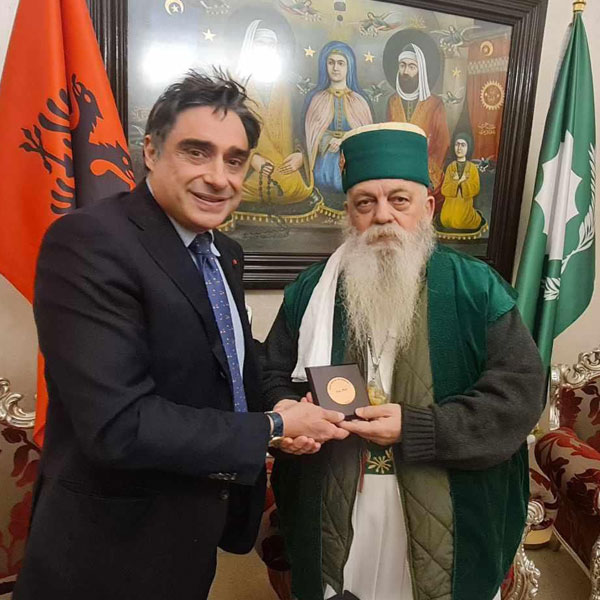
Throughout my journey as President of the Institute for Advanced Studies and Cooperation, I have had the honor of engaging with remarkable figures who shape the fabric of our world. Among them, Baba Mondi, the spiritual leader of the Bektashi Order, stands as a beacon of peace, interreligious dialogue, and wisdom. Meeting him on multiple occasions, I have witnessed first-hand his unwavering commitment to fostering understanding between cultures, religions, and traditions.
Bridging the Divide: Faith as a Unifying Force
In our conversations, Baba Mondi and I always returned to a shared belief: that faith, when practiced with openness, becomes a force for unity rather than division. His leadership within the Bektashi Order, a Sufi path known for its inclusivity and deep spirituality, is a testament to how religion can serve as a bridge between nations, peoples, and belief systems.
As someone deeply engaged in promoting ethical AI, cybersecurity, and digital inclusion, my work often focuses on how technology can either divide or unite us. In many ways, faith traditions have been grappling with these same issues for centuries—how to foster unity in diversity, how to guide human progress ethically, and how to ensure that no one is left behind.
In our discussions, Baba Mondi and I explored the intersection of ethics, governance, and faith in shaping the future of global cooperation. Whether through advancing humanitarian projects, promoting education, or creating platforms for interfaith dialogue, we recognized the responsibility that leaders—spiritual and secular—must uphold in shaping a more just and compassionate world.
As I continue my work, I carry forward the insights gained from our conversations, inspired by the wisdom of those like Baba Mondi who dedicate their lives to building bridges rather than walls. The path to a better world is not walked alone—it is shaped by those who have the courage to engage, to listen, and to act with both conviction and compassion.