
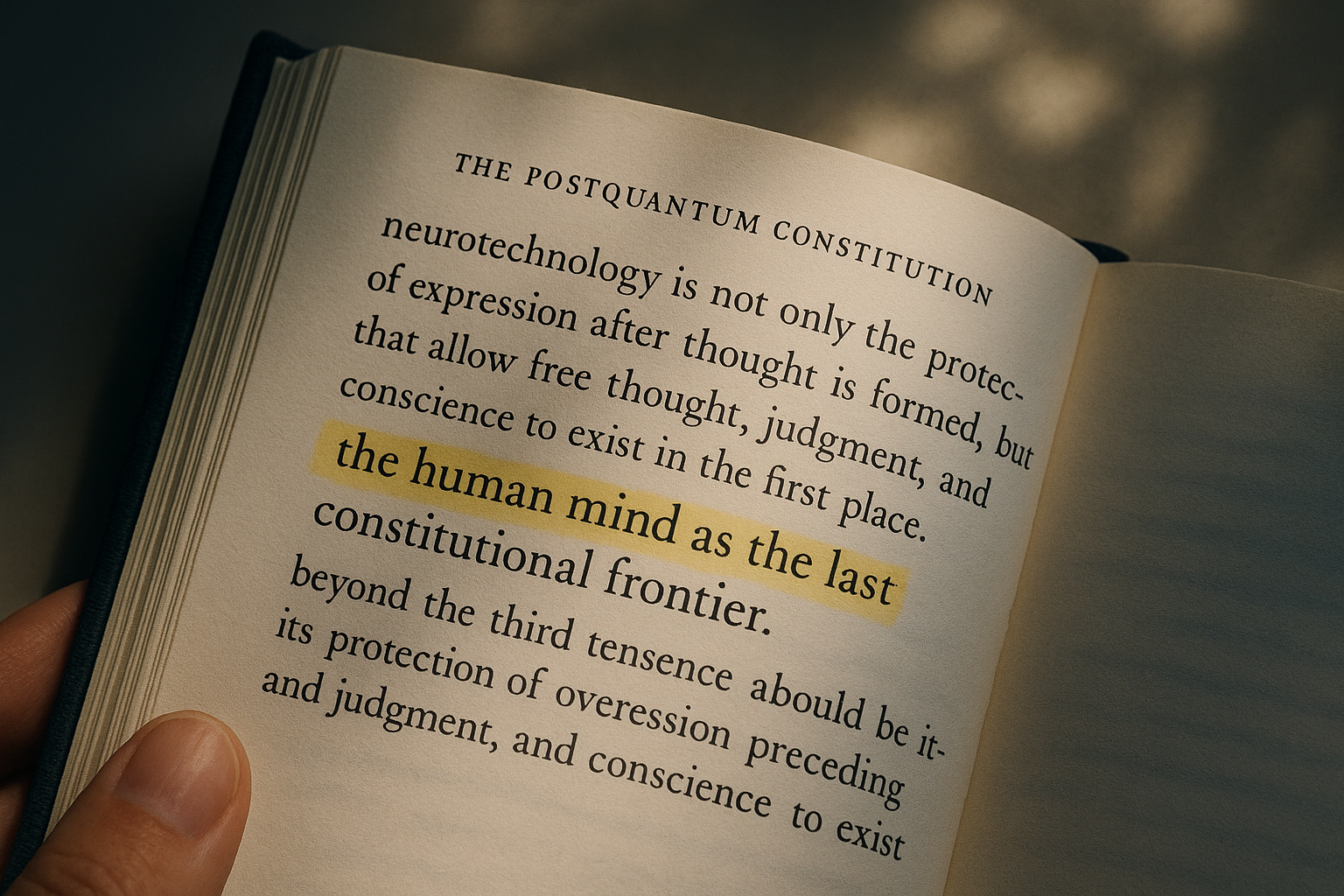
“The constitutional challenge of the twenty-first century is therefore no longer confined to protecting territory or regulating institutions; it increasingly concerns the protection of the human mind as the last constitutional frontier.”
This is not a metaphor of anxiety. It is a constitutional diagnosis.
Modern constitutionalism has learned to protect speech, religion, conscience, privacy, association and political participation. It has built guarantees around the visible acts of freedom: the words spoken, the vote cast, the belief professed, the institution challenged, the authority limited. Yet every one of these acts presupposes something prior and more delicate: the formation of inner judgment.
Before speech, there is attention. Before deliberation, there is perception. Before conscience becomes public, it must remain inwardly free.
The decisive transformation introduced by artificial intelligence, neurotechnology and algorithmic infrastructures is that power no longer operates only after judgment has appeared. It increasingly acts within the environments where judgment is formed. It orders relevance. It predicts behavior. It filters information. It personalizes persuasion. It can intensify fear, reward impulse, fragment context and shape the cognitive atmosphere in which a person believes he is choosing freely.
This does not mean that technology abolishes freedom. It means that constitutional thought must become precise enough to see where freedom now becomes vulnerable.
Cognitive Constitutionalism begins from this point. It recognizes cognitive liberty, mental autonomy, informational integrity and the integrity of human consciousness as constitutional interests requiring explicit protection. The language may sound new, but the concern is ancient. Every serious constitutional tradition has known that the inner sphere of thought and conscience cannot be treated as an ordinary object of power. What has changed is the technical capacity to reach that sphere indirectly, continuously and at scale.
The human mind is not only a private interiority. It is the place where democratic legitimacy begins. A citizen who speaks without having been able to think freely is not fully exercising freedom of expression. A voter whose informational environment has been systematically distorted is not merely misinformed; the constitutional quality of his judgment has been weakened. A society in which attention is permanently captured and belief is continuously engineered may preserve the rituals of liberty while eroding its cognitive foundations.
Freedom of speech depends on freedom before speech.
This distinction matters because many legal and institutional responses still arrive too late. They address content once it circulates, decisions once they are made, harms once they become measurable, manipulation once it has already entered the nervous system of public life. Necessary as these responses are, they remain downstream. The constitutional question now moves upstream: what guarantees protect the conditions under which a person can still form an independent judgment?
Informational integrity becomes central here. It does not require uniformity of opinion or paternalistic control over public discourse. A free society must tolerate error, disagreement, provocation and uncertainty. But it cannot be indifferent to architectures that systematically degrade the conditions of understanding. Pluralism is not noise. Freedom is not cognitive abandonment. The constitutional order must distinguish between the disorder that belongs to liberty and the engineered manipulation that makes liberty less real.
Mental autonomy also requires a more mature concept of technological responsibility. If artificial intelligence and neurotechnology are power technologies, their legitimacy cannot depend only on efficiency, market adoption or technical brilliance. Systems capable of influencing perception, preference and decision-making must remain accountable to human dignity. Their design, deployment and governance must be measured not only by what they allow us to do, but by what they do to the human capacity to judge.
This is why the protection of the mind cannot be reduced to individual privacy. Privacy protects access to information about the person. Cognitive Constitutionalism asks a deeper question: who or what is shaping the conditions inside which the person becomes capable of thought, conscience and choice? The difference is essential. One concerns intrusion. The other concerns formation.
The constitutional tradition is strongest when it protects what power is most tempted to instrumentalize. Once, that meant territory, bodies, property, institutions and public speech. Today it also means attention, cognition, belief formation and the invisible ecology of judgment. The frontier has moved because power has moved.
A constitution worthy of the technological age must therefore defend the inner preconditions of freedom with the same seriousness with which it defends its public expressions. If the human mind becomes the last constitutional frontier, the task is not to isolate thought from technology, but to ensure that technology never becomes the hidden sovereign of thought. The deepest freedom of a person is not only the right to speak. It is the possibility of arriving at speech through a mind that has not been quietly dispossessed.
This reflection is developed from the constitutional vision of The Postquantum Constitution.