
From Riyadh to Dubai and Lake Como: advancing the international dialogue on quantum technologies, resilience, trust and the infrastructures of the post-quantum era
Cernobbio, Lake Como — 14–16 October 2026
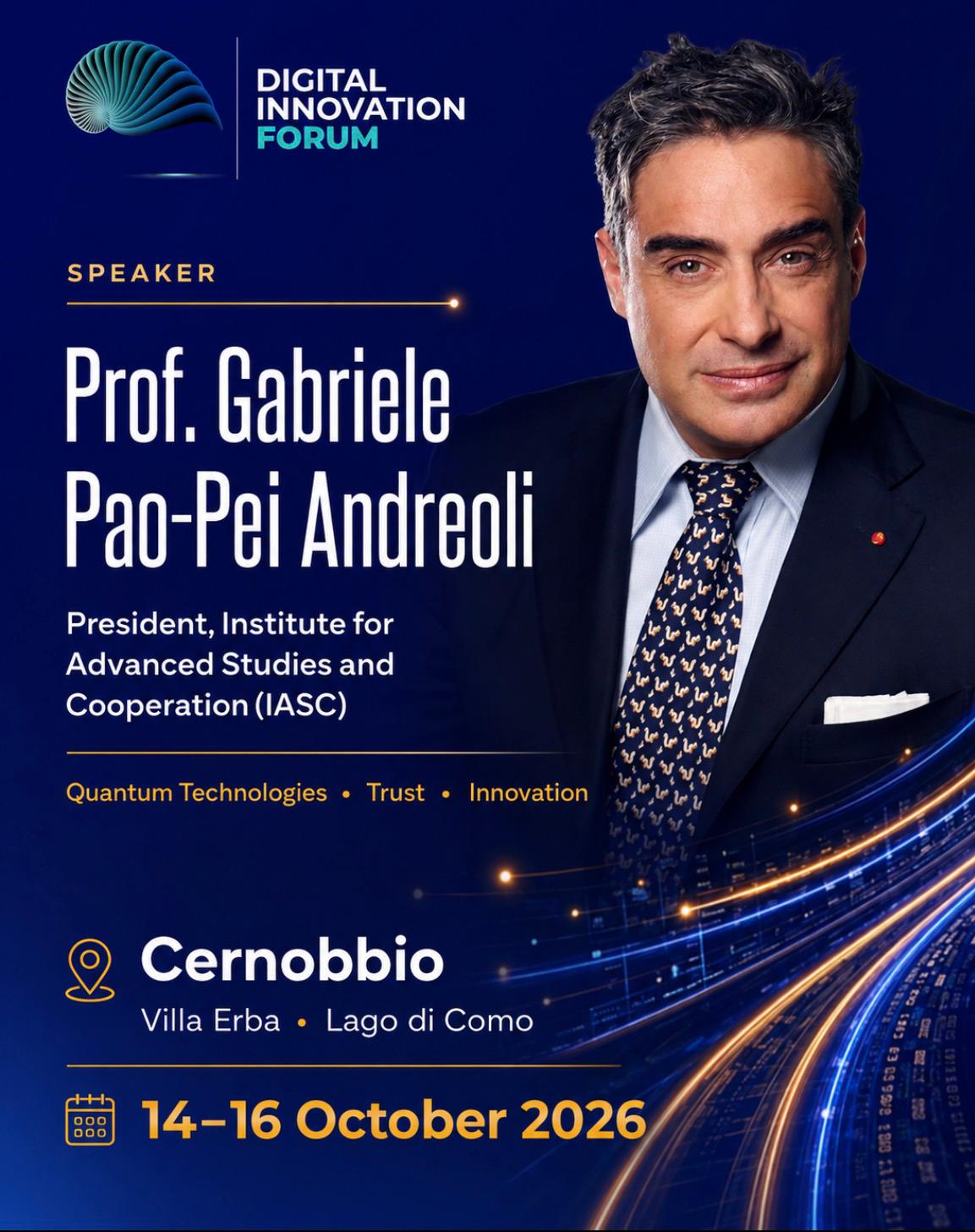
Prof. Gabriele Pao-Pei Andreoli, President of the Institute for Advanced Studies and Cooperation (IASC), will participate as a speaker in the Digital Innovation Forum 2026, taking place from 14 to 16 October at Villa Erba in Cernobbio, Lake Como.
The Forum will provide an important European platform for dialogue on technological transformation, innovation and the rapidly evolving relationship between emerging technologies, institutions, economies and society.
Prof. Andreoli’s participation comes at a particularly significant moment in IASC’s international engagement on quantum technologies, post-quantum security and quantum resilience.
From Saudi Arabia to Dubai: an intensive quantum agenda
The Lake Como discussions follow two major international engagements dedicated to the development of the quantum ecosystem.
In August, Prof. Andreoli participated in World Quantum Day 2026 in Riyadh, where IASC was a partner of the Center for the Fourth Industrial Revolution Saudi Arabia, within the World Economic Forum’s global C4IR ecosystem.
During the Riyadh programme, he moderated the panel “From Risk to Resilience: Quantum Technologies for the Financial Sector,” bringing together perspectives from financial institutions, international organizations and the technology sector.
The discussion reflected a fundamental transition now taking place internationally: quantum is increasingly moving beyond the domain of theoretical research toward questions of implementation, security, economic competitiveness and institutional preparedness.
At the end of September, Prof. Andreoli will return to the Gulf for Quantum Innovation Week in Dubai, where IASC will continue its engagement with the international quantum community and Prof. Andreoli will present his work on the Post-Quantum Constitution, addressing the wider implications of technological transformation for governance, trust, human flourishing and international cooperation.
Lake Como: assessing the maturity of the quantum transition
The Digital Innovation Forum in Italy will therefore represent a further stage in a dialogue extending across Europe, the Gulf and the wider international community.
At Villa Erba, Prof. Andreoli will contribute to discussions concerning the maturity of quantum technologies and the development of quantum-resilient infrastructures, with particular attention to the transition from awareness to practical institutional readiness.
The central question is no longer simply when quantum technologies will become relevant.
The more strategic question is whether governments, financial institutions, critical infrastructure operators and societies are preparing sufficiently early for the profound transformation they may generate.
This requires an integrated approach encompassing quantum computing, post-quantum cryptography, cybersecurity, artificial intelligence, critical infrastructure, policy and international cooperation.
“We are entering a phase in which quantum must increasingly be understood not only as a scientific frontier, but as an infrastructure question. Resilience, interoperability and trust must be designed before technological disruption occurs. Riyadh, Dubai and now Lake Como provide three important perspectives from which to evaluate how far we have progressed and what still needs to be built.”
— Prof. Gabriele Pao-Pei Andreoli
Quantum resilience as an international priority
For IASC, quantum resilience represents a particularly important dimension of the emerging technological landscape.
The arrival of increasingly powerful quantum capabilities will have consequences extending far beyond computing itself. Existing encryption systems, digital identities, financial networks, government communications, health data, critical infrastructure and global supply chains must progressively be assessed against a changing technological environment.
Preparing for this transition therefore cannot remain exclusively a technical exercise.
It requires cooperation among scientists, governments, industry, financial institutions, universities and international organizations, together with governance models capable of maintaining trust during periods of profound technological acceleration.
This philosophy is closely connected with the work being developed through the Quantum Balkan Initiative, founded by Prof. Andreoli to encourage regional cooperation, knowledge transfer, quantum education and post-quantum preparedness across Southeast Europe.
Connecting technological innovation with public policy
Prof. Andreoli will also bring to the Forum his perspective as External Advisor to the Minister of Economy and Innovation of Albania, contributing to the dialogue on how smaller and emerging economies can participate meaningfully in the next generation of technological infrastructures.
For such countries, the quantum transition presents both challenges and opportunities.
Rather than attempting to reproduce the technological ecosystems of the world’s largest economies, regional cooperation can enable countries to develop specialized competencies, attract scientific and technological partnerships, strengthen cybersecurity and build new bridges between research, government and investment.
The objective is therefore not simply technological adoption, but the construction of resilient knowledge ecosystems capable of participating in the emerging quantum economy.
From innovation to trust
The sequence of international engagements — Riyadh, Dubai and Lake Como — reflects a broader direction in IASC’s work: connecting frontier science with diplomacy, governance and institutional transformation.
As quantum capabilities continue to advance, the international conversation must progressively evolve from What can quantum technology do? toward equally important questions:
How should we prepare for it? How do we protect our institutions? How do we preserve trust? And how can technological progress contribute to human flourishing rather than simply accelerating existing systems?
The Digital Innovation Forum at Villa Erba will offer an important setting in which to continue that conversation.
For Prof. Andreoli and IASC, it will also provide an opportunity to share the lessons emerging from recent discussions in Saudi Arabia and Dubai while examining, together with European and international leaders, where the quantum transition stands today — and what must now be done to prepare responsibly for what comes next.
Digital Innovation Forum 2026
14–16 October 2026
Villa Erba — Cernobbio, Lake Como, Italy