
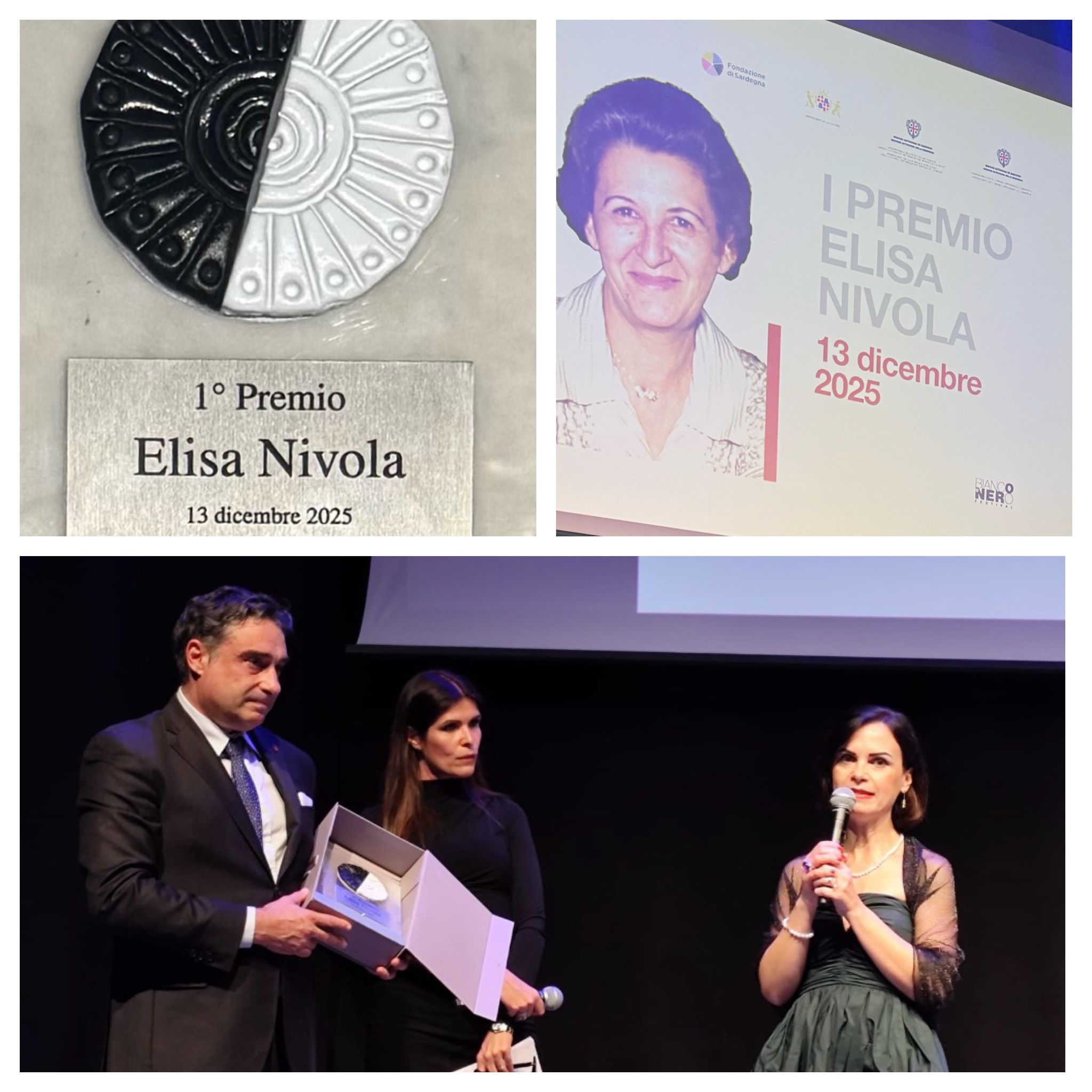
At Teatro Doglio in Cagliari, I had the privilege of sharing meaningful hours with exceptional individuals—Professor Emeritus Luigi Ferrajoli, Alberto Contu, Angelo Binaghi, Elvira Serra, and Dr. Maria Dolores Picciau—on the occasion of the first edition of the Elisa Nivola Prize. 
The Prize was established in memory of Elisa Nivola (1926–2008), widely recognised as a leading Sardinian pedagogue of the late twentieth century—an intellectual and civic figure whose legacy continues to inspire education as a pathway to dignity, responsibility, and human development. 
In this inaugural edition, I was deeply honoured to receive recognition for my social commitment and service, carried out with determination in my role as President of the Institute for Advanced Studies and Cooperation (IASC). I accept this award with humility, as an encouragement to persevere, and as a reminder that concrete service—especially when sustained over time—can become a credible form of leadership. This evening held an added symbolic value for me because it took place alongside the recognition awarded to Professor Luigi Ferrajoli, honoured within the Prize programme in the Research category.  Standing beside a master of legal philosophy and civic thought reinforced the profound link between rigorous reflection and public responsibility—between the work of ideas and the duty to translate them into institutions, protections, and opportunities for people.
Beyond the ceremony itself, what I will carry forward is the quality of the dialogue: an atmosphere in which culture, ethics, education, and social impact were not treated as separate domains, but as dimensions of a single horizon. It is precisely from this convergence that the evening offered valuable insights and, I believe, the premises for future collaboration—with Sardinia, with its cultural actors, and with those who share the conviction that education and service remain among the most powerful forms of social transformation.
I express my sincere gratitude to the organisers and to all those who made this first edition possible, within the broader cultural commitment promoted by Bianco e Nero.