
author · admin · 2
The English Revised Edition of World Federal Constitutionalism and Technologies of Power in the Quantum Age – April Release
I am pleased to announce the forthcoming publication of the English revised edition of my book, World Federal Constitutionalism and Technologies of Power in the Quantum Age.
The Italian edition, released in January, marked the beginning of an important and timely dialogue on the transformation of global governance in the era of artificial intelligence, advanced digital infrastructures, and quantum technologies. It offered a constitutional and guarantor-based reflection on how emerging technologies are reshaping sovereignty, power structures, and international cooperation.
The upcoming English edition represents a significantly revised and expanded work. It is not merely a translation, but an enriched volume that includes:
• New institutional documents
• Further elaboration of the constitutional project for world peace
• Expanded reflections on technological power in the quantum age
• A strengthened framework oriented toward human flourishing
We are living through a systemic transition. Technologies of power are increasingly embedded in algorithms, data architectures, and quantum infrastructures. In this evolving landscape, constitutional guarantees must advance accordingly. The core question is no longer whether technological systems will reshape global order but how we ensure that this transformation serves peace, dignity, responsibility, and the common good.
This book proposes a federal guarantor-based constitutional framework designed to address these challenges with pragmatic and actionable pathways. It seeks to move beyond theoretical debate toward constructive institutional design, capable of safeguarding humanity within an accelerated technological civilization.
I will have the honor of presenting the English edition during Quantum Week in Dubai, where it will contribute to an international dialogue on governance, innovation, and the ethical architecture of the future.
The April release therefore represents not only a publication milestone, but a renewed invitation to scholars, policymakers, technologists, diplomats, and global leaders to engage in shaping a constitutional paradigm adequate for the quantum age.
The journey toward peace and flourishing continues.
At Capitol Hill presenting the new technical infrastructure for world peace and flourishing
From Sustainability to Flourishing in the Quantum Age
A Regenerative Architecture of Peace for Humanity
Esteemed Spiritual Leaders and Diplomats,
Ladies and Gentlemen,
We are living in a time of extraordinary paradox.
Never before has humanity possessed such technological power, scientific knowledge, and global connectivity yet never have we faced such systemic fragility, polarization, and planetary risk.
This paradox reveals something essential:
the central challenge of our time is no longer technological capacity,
but political, constitutional, and ethical architecture.
At WEF in Davos yesterday leaders have spoken of the essential need for a new world order, it is about time. We are already working in that direction.
In recent days, I was at Vatican seeking guidance from His Eminence Cardinal Pietro Parolin, Secretary of State of the Holy See and we reflected on a question that is at once urgent and hopeful:
How can humanity move beyond fragmented efforts and begin to shape a shared constitutional pathway for peace, for human dignity, and for the regeneration of Mother Earth ?
How can we transition from sustainability to flourishing?
The conclusion was clear: we must work together through institutions, through commitments, and through technological guarantees, because what humanity needs today is not merely better tools, but a new framework of trust.
A framework capable of translating ethical intention into credible, verifiable, and enforceable cooperation across borders, systems, and generations.
For many years, sustainability has guided political discourse.
To sustain is to hold, to resist, to maintain balance.
And balance, when treated as an end rather than a phase, becomes stasis.
In living systems biological, social, and civilizational stasis is not life.
The challenges we face climate instability, geopolitical conflict, inequality, and the concentration of technological power cannot be solved by containment alone.
This is why we must move from sustainability to flourishing.
Flourishing is not rhetoric.
It is a principle of governance.
To flourish means designing economic, political, and technological systems that generate more life, more dignity, more trust, and more shared prosperity over time.
Sustainability asks: How do we survive longer?
Flourishing asks: How do we harmonize and strive together?
Flourishing is generative.
And the pathway to flourishing is harmony the alignment of freedom with responsibility, innovation with ethics, sovereignty with cooperation, and progress with protection and trust.
For the first time in human history, this vision is no longer confined to moral aspiration.
We now possess a technological platform capable of making it real.
An enabling infrastructure that allows ethics to move from intention to implementation:
- Ethical synthetic intelligence, supporting decision-making while preserving human accountability and dignity.
- Decentralized blockchain systems, ensuring transparency, trust, and institutional integrity beyond centralized power;
- Quantum and post-quantum sciences, strengthening security and transforming strategy because in an interconnected world, domination produces instability, while cooperation generates antifragility.
So for the first time in human history finally this convergence changes the very logic of power.
It allows us for the first time to envision a world federation of states grounded in a guaranties constitutional framework.
Not a global government.
Not an empire.
But a federation of guarantees:
limits to power,
protection of rights,
constitutional safeguards for dignity, peace, harmony, and the regeneration of our relationship with the Earth.
Peace has to a be Strategic Infrastructure
For too long, peace has been treated as a moral aspiration or a diplomatic outcome.
But peace has failed repeatedly because it lacked institutional and economic infrastructure.
War remained profitable because peace was structurally weak too dependent on personalities, too vulnerable to manipulation, too exposed to the capture of institutions.
That equation can now change.
In a regenerative paradigm, peace becomes:
- economically advantageous,
- strategically stabilizing,
- technologically innovative,
- and socially resilient.
Cooperation scales better than conflict.
Trust multiplies economic and social value faster than fear.
Regenerative systems outperform extractive ones.
In this model, peace is not only ethical it is strategically and economically superior.
But this transformation requires a decisive evolution in governance thinking.
Ethics must move from aspiration to architecture it must be embedded by design.
Ethical AI is not decoration it is a safeguard.
Decentralization is not ideology it is institutional antifragility.
Garantist constitutionalism is not theory it is protection against the systemic abuse of power.
Without ethics, technology accelerates inequality and instability.
With ethics, technology becomes an engine of flourishing.
Through the work of the Institute for Advanced Studies and Cooperation and the IASC World Changers, these principles are already being translated into action.
We are building platforms for scientific and technological diplomacy,
spaces for spiritual dialogue beyond ideology,
constitutional and policy proposals aligned with emerging technologies,
and practical frameworks where peace is treated as a system, not a slogan.
Not ideology but governance.
Not utopia but institutional design.
Not theory but action.
And this brings me to the essential invitation of today.
A constitution is not merely a text.
A constitution is a shared commitment to a future.
We believe the time has come to give momentum to a new guarantist constitutional pathway for peace one that can be endorsed, undersigned, and advanced by institutions, leaders, and citizens of conscience.
I therefore invite you to engage, to follow this work, to contribute to it, to undersign it, and encourage others to do the same.
Because the future is no longer something we merely debate.
It is something we are now responsible to design together through policy, law, technology, and leadership.
We started, let us embrace as only spiritual leaders can
Let us build a peace that is structured, safeguarded, and regenerative.
Thank you.


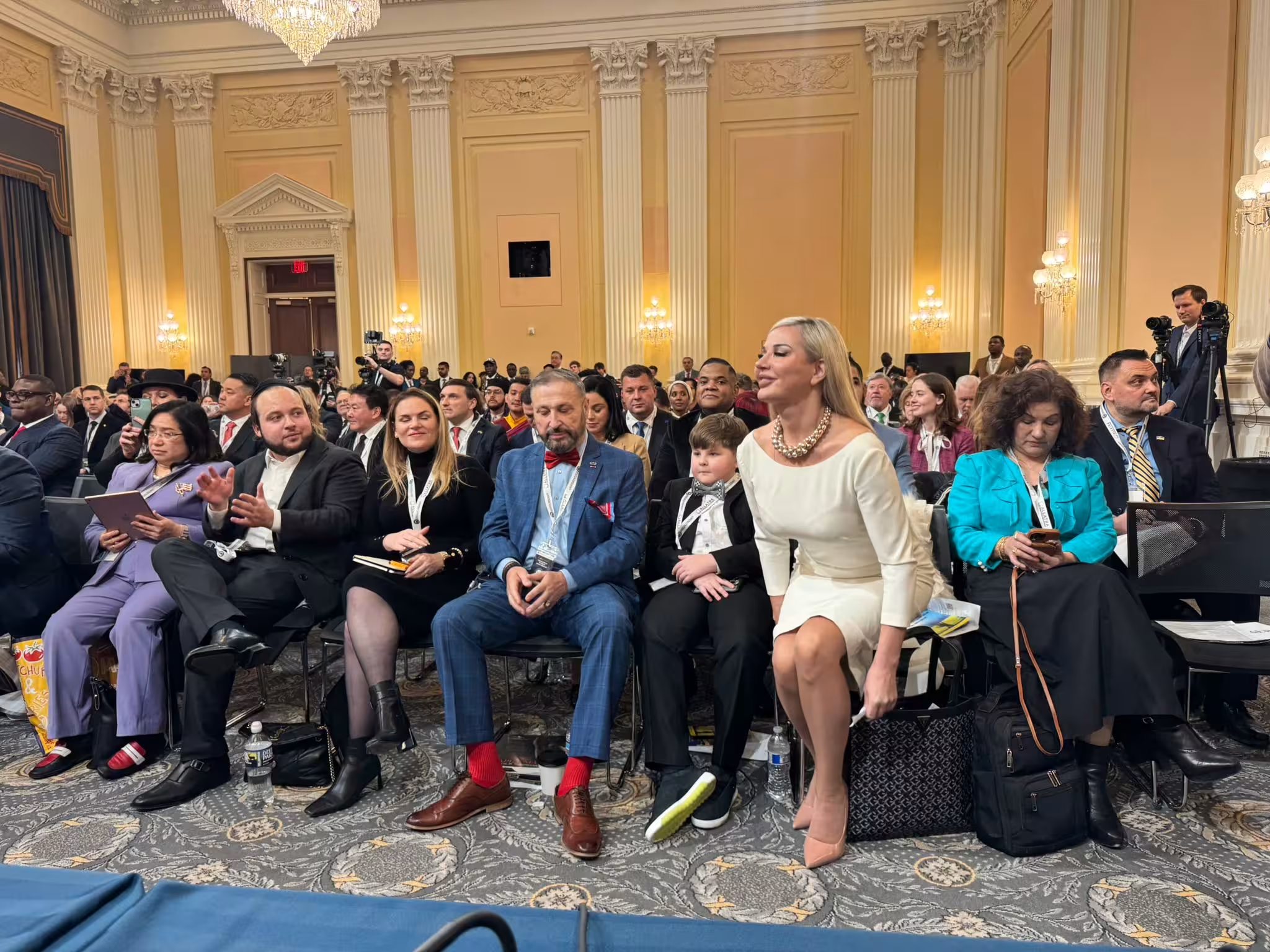
Prof. Andreoli from Venezuela to Capitol Hill: Scientific and Spiritual Diplomacy for Peace and Human Rights
By Prof. Gabriele Pao-Pei Andreoli
President, Institute for Advanced Studies and Cooperation (IASC)
Member of the Consultative Council for International Human Rights of the Military Ordinariate of Venezuela,
in collaboration with the International Office O.O.M.M. – Human Rights Department
⸻
At this particular moment in history marked by renewed conflicts, geopolitical instability, and a growing erosion of respect for international order the responsibility of speaking about peace cannot be taken lightly. Peace today is no longer a stable framework within which politics operates; it has become a fragile condition that must be consciously protected, ethically governed, and institutionally renewed.
It is within this context that I am travelling to Washington, D.C., to take part in the gathering of spiritual leaders at Capitol Hill. This participation represents for me not only an honour, but a profound responsibility academic, institutional, and human.
This year, as in many previous ones, I was faced with a familiar choice: to be present at the World Economic Forum in Davos or to join this gathering in Washington. While Davos remains an important space for dialogue on economics, technology, and global cooperation, the decision this time was immediate. In a period marked by increasing aggressions and weakening respect for international norms and boundaries, it felt essential to be present where conscience and institutions meet directly.
On this occasion, I will present the work developed together with Professor Alberto Contu, entitled:
Global Constitutionalism and Technologies of Power – An Ethical-Garantist Compendium for World Peace
Inspired by the ethical-constitutional thought of Luigi Ferrajoli, this work advances a clear premise: peace is not a moral abstraction or a political slogan. It is a constitutional condition. Without enforceable guarantees, limits to arbitrary power, and institutional accountability, peace remains rhetorical and human rights remain exposed.
Today, however, power no longer operates only through visible political or military structures. It increasingly acts through technologies: artificial intelligence, algorithmic governance, data infrastructures, and emerging computational systems that shape decisions long before the law can intervene. In this context, scientific diplomacy becomes essential not as a celebration of innovation, but as a responsibility to govern knowledge and technology as strategic infrastructures of rights, dignity, and peace.
My presence in Washington is further shaped by my role as Member of the Consultative Council for International Human Rights of the Military Ordinariate of Venezuela, in collaboration with the International Office O.O.M.M. – Human Rights Department. This mandate constantly reminds me that peace is never theoretical. It concerns the concrete protection of human dignity, particularly in contexts affected by conflict, militarization, and institutional fragility.
From this perspective, Venezuela is not merely a geopolitical reference, but a place of responsibility. It represents the lived reality of how fragile peace becomes when guarantees weaken, and how essential it is that human rights remain anchored in ethical and legal foundations rather than contingent political interests.
Here, spiritual diplomacy plays an irreplaceable role. Not as a substitute for law or institutions, and not as proselytism, but as the moral infrastructure that allows trust to emerge where politics alone struggles. Spiritual leaders, scholars, and institutional representatives are called to act together in those spaces where treaties and policies prove insufficient bringing conscience back into governance.
Scientific and spiritual diplomacy, when aligned, offer a powerful response to the challenges of our time. They remind us that technology must serve humanity, not dominate it; that power must be restrained by ethics; and that peace is sustained not only by balances of force, but by shared responsibility.
To be present at Capitol Hill today is therefore not symbolic. It is a conscious choice to contribute to a global dialogue in which law, ethics, science, and spirituality converge in service of peace and human rights.
In times of uncertainty, silence is easier.
Presence is a responsibility.
And it is one I carry with humility, determination, and hope.
Cagliari, the First Edition of the Elisa Nivola Prize: An Honour for Service, and a Commitment to Future Cooperation
At Teatro Doglio in Cagliari, I had the privilege of sharing meaningful hours with exceptional individuals Professor Emeritus Luigi Ferrajoli, Alberto Contu, Angelo Binaghi, Elvira Serra, and Dr. Maria Dolores Picciau on the occasion of the first edition of the Elisa Nivola Prize. 
The Prize was established in memory of Elisa Nivola (1926–2008), widely recognised as a leading Sardinian pedagogue of the late twentieth century an intellectual and civic figure whose legacy continues to inspire education as a pathway to dignity, responsibility, and human development. 
In this inaugural edition, I was deeply honoured to receive recognition for my social commitment and service, carried out with determination in my role as President of the Institute for Advanced Studies and Cooperation (IASC). I accept this award with humility, as an encouragement to persevere, and as a reminder that concrete service especially when sustained over time can become a credible form of leadership. This evening held an added symbolic value for me because it took place alongside the recognition awarded to Professor Luigi Ferrajoli, honoured within the Prize programme in the Research category.  Standing beside a master of legal philosophy and civic thought reinforced the profound link between rigorous reflection and public responsibility between the work of ideas and the duty to translate them into institutions, protections, and opportunities for people.
Beyond the ceremony itself, what I will carry forward is the quality of the dialogue: an atmosphere in which culture, ethics, education, and social impact were not treated as separate domains, but as dimensions of a single horizon. It is precisely from this convergence that the evening offered valuable insights and, I believe, the premises for future collaboration with Sardinia, with its cultural actors, and with those who share the conviction that education and service remain among the most powerful forms of social transformation.
I express my sincere gratitude to the organisers and to all those who made this first edition possible, within the broader cultural commitment promoted by Bianco e Nero.
Light, Dignity and Trust: A Conversation with Fadil Berisha
I push open the door of Fadil Berisha’s New York studio and I know, immediately, that I am not simply entering a workplace. I am stepping into a listening space. The walls look back at me: actors, models, artists, ordinary people. Faces from every corner of the world. Yet what strikes me most is not the fame in the frames, but the silence – a quiet respect for the stories behind each portrait. I am here as President of the Institute for Advanced Studies and Cooperation, but also, and perhaps above all, as a scholar and a friend. Today has a very precise purpose: to understand how Fadil’s creative and deeply positive way of seeing can become one of the living foundations of The Metaverse of Trust, the initiative I am developing to bring ethics, education and beauty into the digital future.
We sit down, surrounded by lights and lenses. The studio is both laboratory and sanctuary. We begin to talk. The conversation flows naturally: his childhood in Kosovo, the early years in New York, the rigor of his craft, the responsibility he feels towards the young people who arrive in his studio full of dreams and vulnerability.
He smiles and says, “Let’s shoot some pictures, let’s make it fun while we talk.” In a moment he becomes one with the studio and his assistants, a synchronised, almost omnipresent being, in touch and in control of all the elements – the light, the camera, the team – and at the same time fully present with me. I see the ease of a master and the attention of a mentor coexisting in every gesture. As he moves and speaks, I recognise something familiar. We are using different tools – he works with a camera, I work with projects that move between technology, diplomacy and education – but we share the same underlying question: how do we honour the human person in a world that moves faster every day? I describe The Metaverse of Trust as I see it: an ecosystem where education, digital media, gaming and new economic models converge around a single axis – the dignity of the human person. A place where young people are not reduced to users or data points, but invited to become co-creators. A world where technology is powerful, yes, but where values set the direction. Fadil immediately grasps both the potential and the risk. He knows how easily an image can create illusions, fuel comparison or flatten identity. He has seen it for decades in the fashion and media industries. Yet his work constantly moves in another direction: he searches for aesthetic excellence without sacrificing truth; he celebrates beauty without erasing age, culture or imperfection; he uses visibility not as a mirror of vanity, but as a platform for stories that matter. We walk through the studio. He points to some of his portraits: faces marked by time; young models at the beginning of their journey; personalities from the Albanian and Balkan communities; icons such as Carmen Dell’Orefice. For each image, he speaks not only of light and composition, but of character, resilience, wounds, dignity.
As I listen, I realise that this way of looking at people is exactly what we need to build into The Metaverse of Trust. Not as decoration, but as structure. We begin to imagine how his visual ethics can become part of the architecture of the project. We talk about a “visual grammar of trust”:
– how we portray faces and bodies without falling into clichés;
– how we represent diversity in a way that feels authentic, not tokenistic;
– how we resist the subtle violence of forced perfection. The conversation naturally shifts to the younger generation. Many live immersed in a continuous stream of images, but few are helped to understand what they see. We agree that our collaboration must have a strong educational dimension. Inside The Metaverse of Trust, Fadil’s experience should not only shape the aesthetic; it should become a school of visual literacy – a place where young people learn not only to produce images, but to read them, to question them, and to use them responsibly. When I step out of the studio that evening, New York is already slipping into its winter light. I walk back onto the street with a clear sensation: the presence of Fadil Berisha on this journey is, for me, a guarantee that beauty will not be separated from responsibility, and that the faces we meet in our digital future will still be recognised as human, fragile, unique – yet powerful. This is the collaboration we are shaping now: a photographer who dedicates his talent to honouring the human spirit, inclusion and creativity, and a project that seeks to bring ethics and trust into the heart of the emerging digital world. It is a story in progress, but it begins from a simple conviction we both share in this present moment: talent reaches its highest form when it is used to inspire, protect and guide.
Beyond Qubits: Quantum, AI and the Human Future of Net-Zero
About ten years ago I was fascinated by a highly counterintuitive book on Quantum Biology, Life on the edge. There are moments in the history of science when a set of ideas, for decades confined to equations and laboratory benches, suddenly migrate into the language of politics, finance and diplomacy. Quantum technologies are living precisely such a moment. For a long time, “quantum” was an adjective reserved for theoretical physicists and a handful of specialised engineers. Today, it appears in national strategies, industrial roadmaps and security doctrines. It has become a keyword for a deeper transition: from the classical digital world we have known for half a century to a new layer of infrastructure in which the rules of information, measurement and computation are subtly but decisively different.
To understand what is at stake, it is useful to remember that we are not starting from zero. The first digital revolution was already “quantum” in its foundations. Transistors, lasers, magnetic resonance: all of these depend on quantum mechanics, but they do so in a diffuse, statistical way. Engineers did not need to manipulate individual atoms or photons. They designed devices whose behaviour could be described, at least effectively, with classical models. The new wave is different. It is explicitly about taking the most counter-intuitive features of the quantum world superposition, entanglement, interference and turning them into controllable resources.
In this perspective, the qubit is not just a technical term: it is almost a symbol. A qubit is a physical system an ion, a superconducting circuit, a trapped atom, a photon that can be prepared in a superposition of two states we call “0” and “1”. When several qubits are entangled, they inhabit a space of possibilities that grows exponentially with their number. We are still very far from fully exploiting this potential; the devices available today are noisy, fragile, and limited in scale. Yet, even in this “intermediate” regime, they already suggest a new way of thinking. Instead of asking whether quantum machines will replace classical ones, it may be more fruitful to ask how they will cooperate, in hybrid architectures that combine quantum processors, high-performance classical computing and artificial intelligence.
The relationship with AI is particularly revealing. On one side, quantum algorithms promise to accelerate some of the mathematical routines that sit at the heart of modern machine learning: optimisation in high-dimensional spaces, sampling from complex distributions, certain forms of linear algebra. On the other side, AI itself is increasingly used to operate quantum hardware: neural networks tune the delicate control pulses that manipulate qubits, reinforcement learning agents search for optimal error-mitigation strategies, advanced data analysis helps to diagnose and reduce noise. Instead of two separate revolutions, we begin to see a single, entangled stack in which quantum and AI continually reinforce each other.
This convergence acquires a special significance when we look at the energy–climate nexus. Many central challenges of the net-zero transition are, at their core, problems of overwhelming complexity. Power grids with high shares of variable renewables must be balanced in real time under uncertainty; materials for batteries, catalysts and membranes must be designed at the molecular level; industrial processes must be simulated and optimised across multiple scales. These are precisely the types of problems where quantum simulation and optimisation, supported by AI and classical supercomputing, may gradually offer an advantage.
The vision that is emerging is not one of a miraculous machine that will “solve climate change”, as some sensational headlines would suggest. It is, rather, the idea that quantum-enhanced tools could become part of a wider repertoire for decarbonisation: helping to discover more efficient materials for electrolysers and CO₂ capture, to operate energy systems with higher shares of renewables, to understand and manage systemic risks in increasingly complex infrastructures. If this vision is realised with sobriety, it may contribute in a tangible way to the net-zero agenda.
At the same time, we would misunderstand the moment if we only told the optimistic half of the story. Quantum infrastructures are themselves demanding in terms of energy and resources. Superconducting qubits need to be cooled to temperatures close to absolute zero; this requires sophisticated cryogenics, specialised materials and non-trivial amounts of electricity. Competing platforms ions in electromagnetic traps, neutral atoms in optical lattices, integrated photonic chips have their own footprints, both in fabrication and operation. And the AI systems that interact with quantum hardware typically run in data centres whose energy and water consumption is already a matter of global concern.
For this reason, any discourse on “quantum for climate” must be honest: we cannot simply put quantum technologies on the side of the solution and forget that they are also part of the problem. A thoughtful approach requires life-cycle analysis, a careful look at supply chains, and a deliberate effort to make the quantum–AI stack itself more efficient and compatible with planetary boundaries. Research on low-power control electronics, more compact architectures, and new materials is not only a matter of performance; it is also a matter of responsibility.
Around this technical and environmental core, a broader strategic landscape is taking shape. In a remarkably short time, quantum technologies have become a terrain of geopolitical competition. Governments speak of quantum in the same breath as they speak of digital sovereignty, strategic autonomy and national security. They fear, with some justification, that a cryptographically relevant quantum computer could one day break the codes that protect state communications, financial transactions and critical infrastructures. In response, they are investing in post-quantum cryptography and in quantum-safe communication networks, even before the threat fully materialises.
This dynamic creates a familiar tension. On one side, quantum research is intrinsically global. It relies on open scientific collaboration, on the circulation of students and ideas, on the sharing of data and benchmarks. On the other, security concerns push in the opposite direction, towards export controls, investment screening, and a more restrictive approach to knowledge flows. Quantum is not the first technology to occupy this dual space between civil and military uses, but the speed and intensity of the current competition give the question a new urgency.
Here the parallel with AI governance is instructive. The issues that surround large-scale AI systems concentration of power in a few platforms, opacity of decision-making, asymmetries between those who design infrastructures and those who merely depend on them reappear, often amplified, in the quantum domain. The convergence of quantum and AI in sensitive sectors such as cybersecurity, finance and surveillance raises the stakes further. It is not hard to imagine scenarios in which quantum-accelerated optimisation and analysis could exacerbate market volatility, distort competitive playing fields, or strengthen intrusive data-collection architectures.
In front of these scenarios, governance is not a luxury that can be added ex post; it is a constitutive dimension. The question is not only how many qubits a country or a company can control, but which frameworks of meaning and value will guide the use of those qubits. This is why the debate on standards, ethical guidelines and regulatory approaches to quantum technologies cannot be postponed until devices are mature and ubiquitous. There is a window narrow, but real in which scientific, technical, legal and ethical reflection can still co-evolve.
Europe’s response is instructive. In recent strategy documents, the European Union increasingly presents quantum technologies as part of a broader effort to anchor digital transformation in the language of rights, democracy and environmental sustainability. Large flagship programmes support research and early industrialisation; at the same time, there is attention to values, to the protection of fundamental rights, to the role of public institutions. Europe does not want to be a mere adopter of technologies imported from elsewhere; it aims to shape their direction.
For Italy, this moment is both demanding and promising. The country has a strong tradition in physics and engineering, with respected schools in quantum optics, condensed matter, information theory. It has an industrial fabric that spans energy, manufacturing, aerospace, robotics, precision mechanics, and an emerging ecosystem of start-ups and innovative SMEs. At the same time, Italy is not a technological superpower in the narrow sense: it cannot simply outspend larger players. Its strength lies elsewhere, in the ability to combine scientific and technical competence with a long-standing humanistic and spiritual heritage, and with a specific vocation for mediation and dialogue.
In the quantum context, this combination could translate into a distinctive role. Italy can and should invest in laboratories, infrastructures and talent. But it can also help to articulate a more comprehensive vision of what a human-centred quantum future might look like: one in which technological ambition is tempered by attention to justice, inclusion and the common good; in which quantum and AI are deployed to support social cohesion and ecological transition, rather than to fuel new asymmetries and forms of exclusion.
Such a vision would rest on a few simple, but demanding, commitments. The first is a commitment to purpose. Not every possible application of quantum technologies deserves the same priority. In a world of finite resources, both material and political, it is legitimate to ask which projects concretely advance human dignity, reduce suffering, strengthen peace, and which merely satisfy curiosity or commercial appetite. The second commitment concerns justice. If quantum infrastructures become essential to economic and security architectures, access to them risks deepening the divide between those who can afford to participate and those who remain spectators. Mechanisms of sharing, cooperation and capacity-building will be necessary to avoid a new technological fracture superimposed on existing inequalities.
A third commitment is transparency and accountability. Quantum systems are intrinsically complex and, for the non-specialist, almost opaque. This makes it all the more important that the institutions and communities who develop and deploy them are subject to forms of oversight, dialogue and public scrutiny. Here again, the experience accumulated in the AI field imperfect and incomplete as it is can offer useful lessons. Finally, there is the commitment to dialogue between different forms of knowledge. Quantum mechanics itself, with its paradoxes and its resistance to classical intuition, has historically stimulated philosophical and even theological reflection. The new quantum technologies invite us to renew that dialogue, not in search of premature harmonisations, but to ensure that the metaphors, narratives and expectations surrounding these tools are not monopolised by a purely technocratic imagination. HSeen in this light, quantum technologies are more than a promising industrial sector or a new instrument in the geopolitical arsenal. They are also a mirror in which our societies reveal their ambitions and their fears, their sense of vulnerability and their desire for control. The way we choose to explore this new territory what we fund, what we regulate, what we forbid, what we celebrate will tell us much about the civilisation we are becoming.
If we succeed in orienting the quantum–AI stack towards the service of life, peace and the integrity of creation, this chapter of technological history will not be reduced to the count of qubits or patents. It will instead be remembered as a moment in which humanity learned, once again, to transform a deeper understanding of matter and information into a deeper responsibility for the world we inhabit.
Transcendence in Rome
Italian Presentation of a Vision for the Future of Humanity
On 21 October 2025, in the magnificent setting of Palazzo Brancaccio in Rome, I had the privilege of presenting, together with the Institute for Advanced Studies and Cooperation (IASC) and the World Changers network, the Italian edition of my book Transcendence: Quantum Computing, AI, and the Future of Humanity.
This work was born from a deep conviction: that artificial and synthetic intelligence, quantum technologies, and emerging innovations must be guided by an ethical, spiritual, and humanistic compass. Transcendence is not merely a technical or speculative volume; it is a call to responsibility, to cooperation, and to a renewed alliance between science, culture, diplomacy, and faith.
I am profoundly honored that the book is introduced by the preface of H.E. Mons. Vincenzo Paglia, whose reflection offers an essential spiritual and ethical framework. His words recall the need to anchor each technological development in an anthropology grounded in responsibility, solidarity, and the protection of life. These principles represent the backbone of Transcendence and of my work within IASC and the World Changers community.
During the evening, Sr. Myriam Castelli enriched our dialogue with her experience in communication between faith, society, and media, giving voice to a message that I consider central: technological progress must remain deeply human, inclusive, and oriented toward service to the common good.
The event was conducted with great elegance and sensitivity by Valeria Altobelli, whose moderation helped create a refined and thoughtful atmosphere, capable of welcoming representatives of institutions, academia, diplomacy, entrepreneurship, and the arts.
I am grateful for the valuable contributions of Karl Nagy and Mete Al (Mete AI), whose collaboration reflects the interdisciplinary spirit of the book and of our common commitment to ethical innovation, secure infrastructures, and new economic and technological paradigms at the service of humanity.
In coherence with the themes explored in Transcendence, the presentation was further elevated by the innovative work of Prof. Filippo Gregoretti, Yair Levy, and Brain.Space, whose research represents a frontier where neurosciences, artificial intelligence, and human experience can interact in a respectful, creative, and generative manner.
A unique artistic and emotional dimension was offered by Maestro Olen Cesari, whose performance translated the spirit of Transcendence into music: an encounter between tradition and future, sensitivity and vision. His art transformed the evening into an immersive experience, in which beauty became a language of dialogue between science, spirituality, and culture.
The Rome presentation of 21 October confirmed my intention and that of IASC and World Changers: to use Transcendence as a platform for scientific diplomacy, ethical reflection, and global collaboration. Those who joined us in Rome religious and academic authorities, innovators, entrepreneurs, artists, leaders and friends testified that it is possible, and necessary, to design a future in which artificial and quantum intelligence are governed with conscience, competence, and compassion.
To each of them goes my deepest gratitude for their trust, their presence, and their commitment to building together a world in which technology does not replace humanity, but elevates it.


The 3rd Saudi Forum for the Fourth Industrial Revolution
Riyadh, October 2025 The 3rd Saudi Forum for the Fourth Industrial Revolution, Frontiers of Global Technology, offered more than a stage for announcements and projections; it created a space where scientific excellence, policy vision, and ethical reflection could meet as partners rather than competitors. Attending in my dual capacity as President of the Institute for Advanced Studies and Cooperation (IASC) and as Liaison to the Pontifical Academy of Theology in Vatican City, I witnessed how a shared language of responsibility can begin to turn technological capability into a grammar of peace. This was made possible by the gracious leadership of Dr. Basma AlBuhairan, Director of the Center for the Fourth Industrial Revolution (C4IR) Saudi Arabia, whose invitation and hospitality enabled a truly substantive dialogue among stakeholders committed to human-centred innovation. The contemporary technological landscape spanning artificial intelligence, advanced computation, biotechnology, and data-driven systems demands more than admiration for novelty. It requires a disciplined ethic of stewardship, a recognition that the measure of progress is not speed or scale alone, but the extent to which new tools protect human dignity, strengthen social cohesion, and widen access to opportunity. In this sense, the Forum in Riyadh was not merely timely; it was exemplary. Conversations moved beyond slogans to address the practical architecture of trust: how to embed transparency and accountability in complex models; how to govern data with integrity across its lifecycle; how to anticipate quantum-era risks to cryptography and infrastructure without paralysing beneficial research and deployment.
IASC’s contribution centred on scientific diplomacy understood as a method of bridge-building: a way of transforming shared technical problems into shared civic purposes. Where political narratives can divide, common epistemic standards measurement, verification, peer scrutiny invite collaboration. Where national interests naturally diverge, the prevention of systemic failure in health, energy, finance, and critical services provides a compelling basis for cooperation. In Riyadh, this meant articulating an agenda that links ethical and inclusive AI to the habits of good governance; that connects quantum readiness to public trust; and that treats education not as an afterthought but as the long horizon on which any strategy stands or falls. Technology, after all, is never neutral in its effects; it reflects the virtues and limits of its makers. “Ethics is not a constraint on progress,” I said during the sessions. “It is the compass that makes progress meaningful.”
This compass points first to the person. Systems should be designed to serve, not to substitute, the human; to augment judgement, not to trivialise it. It also points to justice: the gains and the burdens of innovation must be distributed fairly, with deliberate attention to those least served by current arrangements. Finally, it points to responsibility: foresight, continuous monitoring, and the humility to correct course when harms or unintended consequences appear. These principles, deeply resonant with the Vatican’s long-standing reflection on technology and the human person, found a ready echo in C4IR Saudi Arabia’s commitment to aligning innovation with societal benefit. The alignment is not accidental; it reflects a shared conviction that prosperity without purpose is brittle, and purpose without practical implementation is empty.
From this foundation, the conversations in Riyadh turned naturally to institutional craft how to convert aspiration into practice. Rather than publishing principles that sit untouched on a shelf, participants explored the operational mechanisms that give ethics real traction: impact assessments and audit trails that are proportionate to risk; reproducible evaluation of model behaviour; resilient data provenance; and the disciplined migration to quantum-resilient cryptographic standards. Crucially, these mechanisms gain legitimacy when they are developed across borders and sectors government, academia, industry, and faith-inspired institutions so that trust is earned not by assertion but by performance in the open.
Education emerged as the quiet centre of gravity. Building trustworthy systems presupposes a generation of practitioners and leaders fluent in both technical detail and ethical judgement. The Forum highlighted the need for executive programmes that bring engineers and policymakers into a shared seminar room; for research residencies that link laboratories, universities, and public agencies; for fellowships that treat governance as a craft to be learned, refined, and renewed. In our discussions with C4IR Saudi Arabia, we explored pathways for scholar exchanges and joint publications that move seamlessly from principle to playbook, from case study to standard, from pilot to scaled deployment. Such vehicles of exchange do not merely disseminate knowledge; they create the habits of cooperation that sustain peace.
Peace itself often invoked, less often specified acquires a concrete profile when framed through scientific diplomacy. It is the practical, measurable reduction of risk in systems upon which all depend. It is the decision to share methods before crises force the sharing of blame. It is the commitment to ensure that the benefits of intelligence, whether artificial or augmented, are not the preserve of the few but the patrimony of the many. Seen this way, the Kingdom’s investment in convening the global community around the Fourth Industrial Revolution constitutes not just a technological bet, but a civic one: that stability and flourishing can be engineered, in part, through institutions designed to cooperate.
The gratitude IASC extends to Dr. Basma AlBuhairan is therefore more than ceremonial. It is an acknowledgement of intellectual leadership exercised with grace: convening diverse perspectives, insisting on substance, and keeping the conversation tethered to impact. Under her direction, C4IR Saudi Arabia provided a forum that was rigorous without being narrow, ambitious without being naïve. As partners, we are encouraged to pursue concrete next steps policy notes that inform institutional choices, workshops that translate governance frameworks into implementation guides, and colloquia that hold us accountable for results measured not only in citations or prototypes, but in services that become safer, fairer, and more reliable for ordinary people.
The work ahead is difficult by definition, but it is also deeply hopeful. The very disciplines that make science credible method, transparency, and correction can make societies more peaceful when they are brought into public life. In Riyadh, that hope took practical form. For IASC, it affirmed a simple proposition: that the future is not something to predict, but something to govern for the sake of human dignity. If we keep ethics as our compass and the common good as our destination, the Fourth Industrial Revolution can be remembered not only for the power it unleashed, but for the bridges it built.
Faith-Led Diplomacy for Peace: The Rise of Spiritual Diplomats at Capitol Hill
On December 2, 2025, I will have the honor of speaking at the International Interfaith Conference – “United in Liberty: The Rise of Spiritual Diplomats”, held at the U.S. Capitol Complex in Washington, D.C.
This significant event, hosted by the Spiritual Diplomats Initiative and supported by the ALLATRA International Public Movement, represents a unique moment where faith, science, and diplomacy meet in service of humanity. It reminds us that true peace and progress are born not only from political will, but from a deeper spiritual awareness and a shared sense of purpose.
⸻
Faith as a Foundation for Global Understanding
In today’s world of rapid change and growing complexity, diplomacy must evolve beyond strategy it must embody empathy, conscience, and collaboration.
Faith-led diplomacy does not seek to divide, but to unite; it transcends doctrines and borders to embrace the universal principles of compassion, justice, and human dignity.
This conference offers a vital space for dialogue among spiritual leaders, scientists, diplomats, and visionaries who believe that the future of peace begins within the human heart. Through respectful conversation and shared values, we can bridge the gaps that too often separate nations, cultures, and beliefs.
⸻
Gratitude and Shared Purpose
I am profoundly grateful to Pastor Mike Burns, whose grace and leadership have made this invitation possible, and to the ALLATRA platform, whose tireless work continues to connect people across the world in a spirit of cooperation and truth.
Their commitment to interfaith dialogue and humanitarian values reflects the very essence of what I believe diplomacy should be a channel for light, understanding, and unity.
⸻
Serving Humanity Through Knowledge and Faith
As President of the Institute for Advanced Studies and Cooperation (IASC) and Liaison Representative of the Pontifical Academy of Theology (PaTH) – Vatican City, I see this gathering as an extension of our ongoing mission: to bring together science and spirituality, innovation and ethics, knowledge and conscience.
Through the IASC and the World Changers Summit, we continue to build bridges between communities, fostering a culture of dialogue and ethical advancement. Peace, in this vision, is not merely a political outcome it is a spiritual commitment to the good of all.
The Spiritual Diplomats Conference embodies that very commitment: a collective effort to transform diplomacy into a sacred act of service, where faith guides wisdom, and humanity guides progress.
⸻
Event Details
Event: United in Liberty – The Rise of Spiritual Diplomats
Date: December 2, 2025
Venue: U.S. Capitol Complex, Washington, D.C.
Platform: ALLATRA International Public Movement
Theme: Faith-Led Diplomacy for Peace Beyond Politics
Diplomatic Dialogue for Regional Development: Meeting with H.E. Denion Meidani, Ambassador of Albania to North Macedonia
In an atmosphere of cordiality and shared vision, I had the privilege of meeting H.E. Denion Meidani, Ambassador of the Republic of Albania to North Macedonia. The encounter reflected the spirit of constructive diplomacy that defines our mission at the Institute for Advanced Studies and Cooperation (IASC) where dialogue becomes the foundation for ethical development and cooperation across borders.
H.E. Meidani embodies a remarkable commitment to service and international understanding. Our discussion explored key themes such as regional development, technological innovation, ethical leadership, and the growing importance of diplomacy in an era marked by digital transformation and global interconnectedness.
The exchange also highlighted opportunities for future collaboration between Albania, North Macedonia, and the IASC World Changers network, with a focus on fostering peace, sustainable progress, and intercultural bridges through education, science, and cooperation.
Joining us were my esteemed friend Mr. Ylli Paja, deeply engaged in several regional initiatives, and Mr. Terfan Hasani, a visionary entrepreneur whose work exemplifies the spirit of connectivity and progress in the Balkans. Together, we reaffirmed our shared commitment to building a future where innovation serves humanity and where diplomacy continues to illuminate the path toward unity and ethical advancement.