
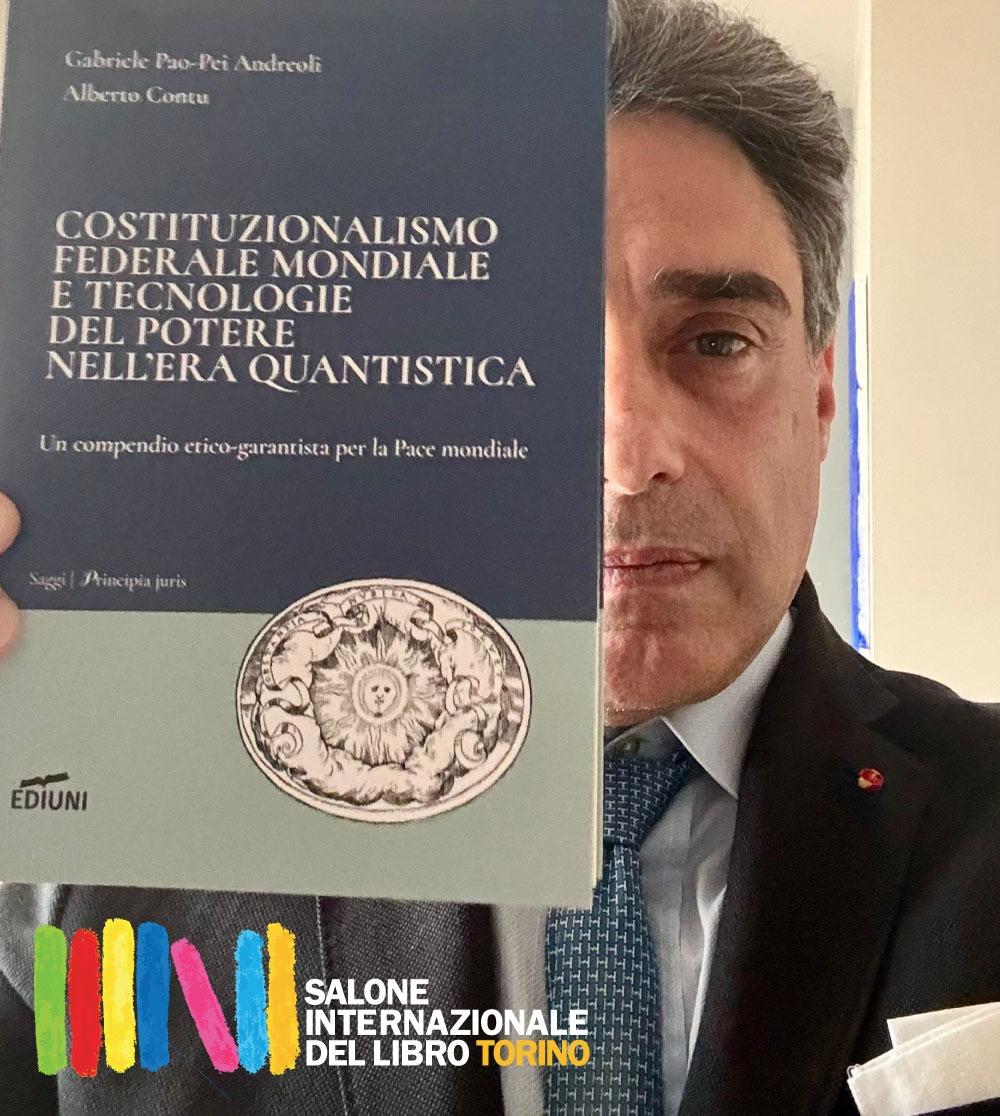
World Federal Constitutionalism and Technologies of Power in the Quantum Era
(Costituzionalismo Federale Mondiale e Tecnologie del Potere nell’Era Quantistica)
On Sunday, 17 May 2026, at 16:30, within the distinguished framework of the International Book Fair in Turin (Salone Internazionale del Libro), I will present my latest work, Costituzionalismo Federale Mondiale e Tecnologie del Potere nell’Era Quantistica (English title: World Federal Constitutionalism and Technologies of Power in the Quantum Era), co-authored with Alberto Contu. The presentation will take place at the Sardinia Stand, Padiglione 2, Lingotto Fiere.
A Living Work at the Intersection of Institutions, Spirituality, and Innovation
This volume must be understood as a work in progress, as a dynamic and evolving framework rather than a fixed doctrine. It is the result of an ongoing international effort developed in synergy with the Institute for Advanced Studies and Cooperation, the World Changers platform, universities, and global institutional partners.
Significantly, this work also finds its roots in a series of high-level dialogues held at Capitol Hill in collaboration with Pastor Burns and a network of global spiritual leaders. These exchanges have contributed to shaping a vision that integrates governance, ethics, and spirituality as complementary dimensions of peacebuilding. The project has further been presented at the highest diplomatic level, including an engagement with His Eminence Cardinal Pietro Parolin, Secretary of State of Vatican City, on 17 January, marking an important step in aligning institutional, spiritual, and intellectual efforts toward a shared global vision.
From Human-Centric to Ethical Human-Centric Systems
While the notion of “human-centric technology” has become widely adopted, this work advances a more precise and demanding perspective: technology can only be meaningful if it is guided by ethical humanity.
The central question is no longer whether systems are human-centered, but whether the humans at the center embody values that are regenerative, responsible, and aligned with the common good. Ethical human-centric technology is therefore not a rhetorical construct, but a necessity.
This approach reflects a broader mission: to foster a transformation of humanity itself, one that begins with the capacity to harmonize internally and extends outward into society, institutions, and global relations.
Harmonization as a New Paradigm for Global Governance
The book introduces a conceptual shift from balance to harmonization. While balance often implies tension between opposing forces, harmonization seeks alignment, coherence, and integration across systems.
In this context, the work proposes a federal guarantist model as a foundation for global governance, one capable of fostering peace, collaboration, and shared responsibility in an era defined by technological acceleration and geopolitical complexity.
The first version of the book, now presented to the public, may be understood as a constitution for peace, order, and collaboration: an initial framework designed to guide future developments and collective contributions.
A Convergence Toward Peace, Disarmament, and Regeneration
The underlying vision is clear: a humanity grounded in ethical values will naturally move toward peace. Such a transformation opens pathways toward disarmament, denuclearization, and a reduction of systemic conflict.
This is particularly urgent in a time where the convergence of artificial intelligence, quantum technologies, and global infrastructures is rapidly redefining the balance of power. Without a corresponding ethical evolution, these advancements risk amplifying instability rather than resolving it.
At the same time, this vision is intrinsically connected to other global priorities—environmental stewardship, energy transformation, and sustainable development. Peace, in this framework, becomes not only a moral imperative but a strategic and civilizational asset.
A Shared Message Across Traditions
This work resonates with the broader call expressed by spiritual leaders worldwide: the necessity of unity, dialogue, and collective responsibility. It echoes a universal message—one that transcends traditions and cultures—affirming that humanity must come together to face its common challenges.
It is in this spirit that the project seeks to build bridges between institutions, disciplines, and communities, reaffirming the role of ethical leadership in shaping the future.
From Turin to Assisi: A Continuing Journey
The presentation at the International Book Fair in Turin represents a key milestone in this ongoing journey. It offers a space for intellectual exchange and public engagement on the future of global governance and ethical technology.
This path will continue on 2 June 2026 in Assisi, in a symbolic moment marking the 800th anniversary of the legacy of Saint Francis—a figure whose message of harmony, humility, and universal fraternity remains profoundly relevant today.
An Invitation to Co-Create a New Civilization
This book is not an endpoint, but a beginning. It invites institutions, leaders, scholars, and citizens to participate in a collective endeavor: to build a new civilization grounded in peace, harmony, value, and regeneration.
In a moment of unprecedented convergence between technology and human destiny, the opportunity and responsibility, to shape the future has never been greater.