
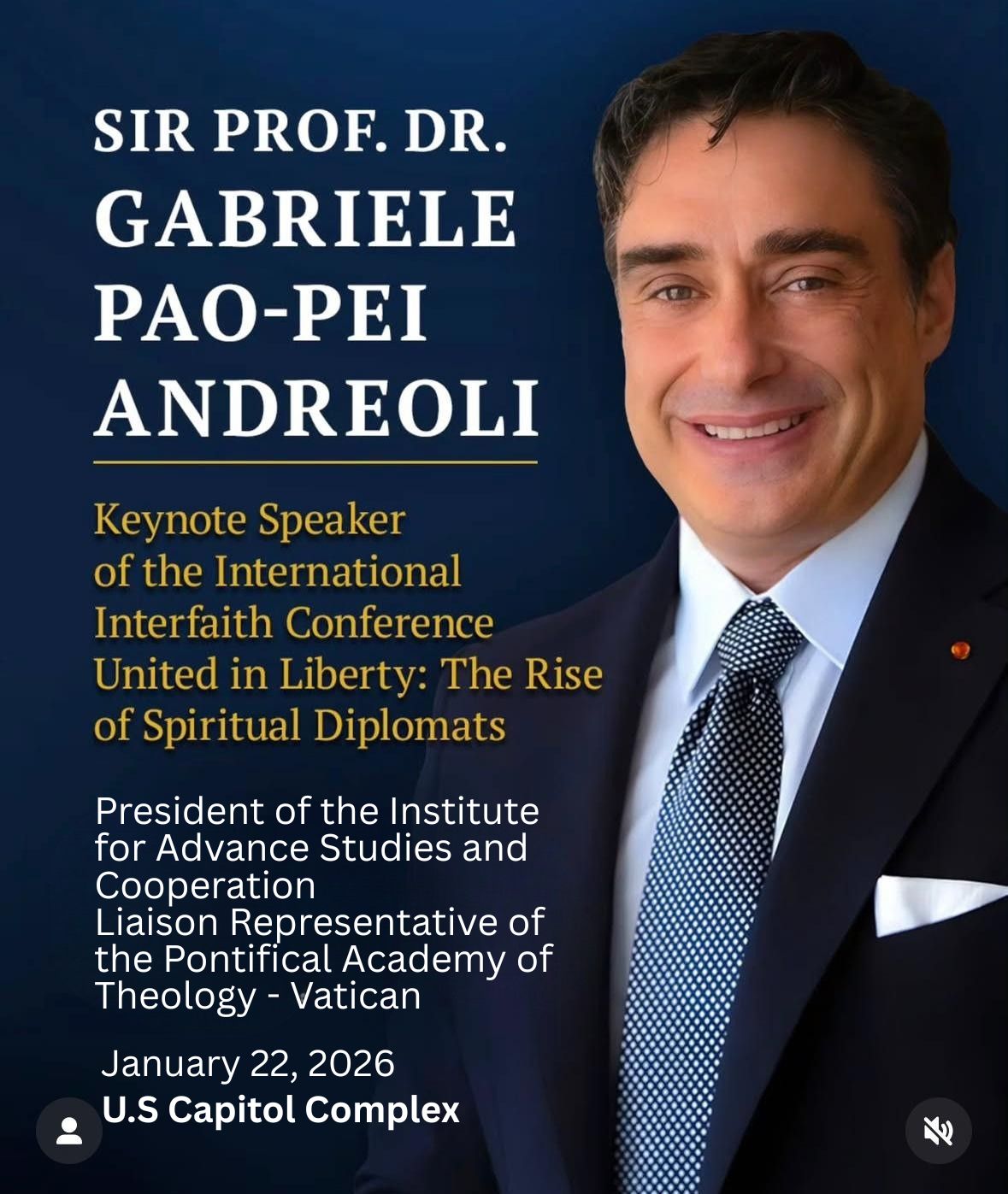
By Prof. Gabriele Pao-Pei Andreoli
President, Institute for Advanced Studies and Cooperation (IASC)
Member of the Consultative Council for International Human Rights of the Military Ordinariate of Venezuela,
in collaboration with the International Office O.O.M.M. – Human Rights Department
⸻
At this particular moment in history—marked by renewed conflicts, geopolitical instability, and a growing erosion of respect for international order—the responsibility of speaking about peace cannot be taken lightly. Peace today is no longer a stable framework within which politics operates; it has become a fragile condition that must be consciously protected, ethically governed, and institutionally renewed.
It is within this context that I am travelling to Washington, D.C., to take part in the gathering of spiritual leaders at Capitol Hill. This participation represents for me not only an honour, but a profound responsibility—academic, institutional, and human.
This year, as in many previous ones, I was faced with a familiar choice: to be present at the World Economic Forum in Davos or to join this gathering in Washington. While Davos remains an important space for dialogue on economics, technology, and global cooperation, the decision this time was immediate. In a period marked by increasing aggressions and weakening respect for international norms and boundaries, it felt essential to be present where conscience and institutions meet directly.
On this occasion, I will present the work developed together with Professor Alberto Contu, entitled:
Global Constitutionalism and Technologies of Power – An Ethical-Garantist Compendium for World Peace
Inspired by the ethical-constitutional thought of Luigi Ferrajoli, this work advances a clear premise: peace is not a moral abstraction or a political slogan. It is a constitutional condition. Without enforceable guarantees, limits to arbitrary power, and institutional accountability, peace remains rhetorical—and human rights remain exposed.
Today, however, power no longer operates only through visible political or military structures. It increasingly acts through technologies: artificial intelligence, algorithmic governance, data infrastructures, and emerging computational systems that shape decisions long before the law can intervene. In this context, scientific diplomacy becomes essential—not as a celebration of innovation, but as a responsibility to govern knowledge and technology as strategic infrastructures of rights, dignity, and peace.
My presence in Washington is further shaped by my role as Member of the Consultative Council for International Human Rights of the Military Ordinariate of Venezuela, in collaboration with the International Office O.O.M.M. – Human Rights Department. This mandate constantly reminds me that peace is never theoretical. It concerns the concrete protection of human dignity, particularly in contexts affected by conflict, militarization, and institutional fragility.
From this perspective, Venezuela is not merely a geopolitical reference, but a place of responsibility. It represents the lived reality of how fragile peace becomes when guarantees weaken, and how essential it is that human rights remain anchored in ethical and legal foundations rather than contingent political interests.
Here, spiritual diplomacy plays an irreplaceable role. Not as a substitute for law or institutions, and not as proselytism, but as the moral infrastructure that allows trust to emerge where politics alone struggles. Spiritual leaders, scholars, and institutional representatives are called to act together in those spaces where treaties and policies prove insufficient—bringing conscience back into governance.
Scientific and spiritual diplomacy, when aligned, offer a powerful response to the challenges of our time. They remind us that technology must serve humanity, not dominate it; that power must be restrained by ethics; and that peace is sustained not only by balances of force, but by shared responsibility.
To be present at Capitol Hill today is therefore not symbolic. It is a conscious choice to contribute to a global dialogue in which law, ethics, science, and spirituality converge in service of peace and human rights.
In times of uncertainty, silence is easier.
Presence is a responsibility.
And it is one I carry with humility, determination, and hope.