
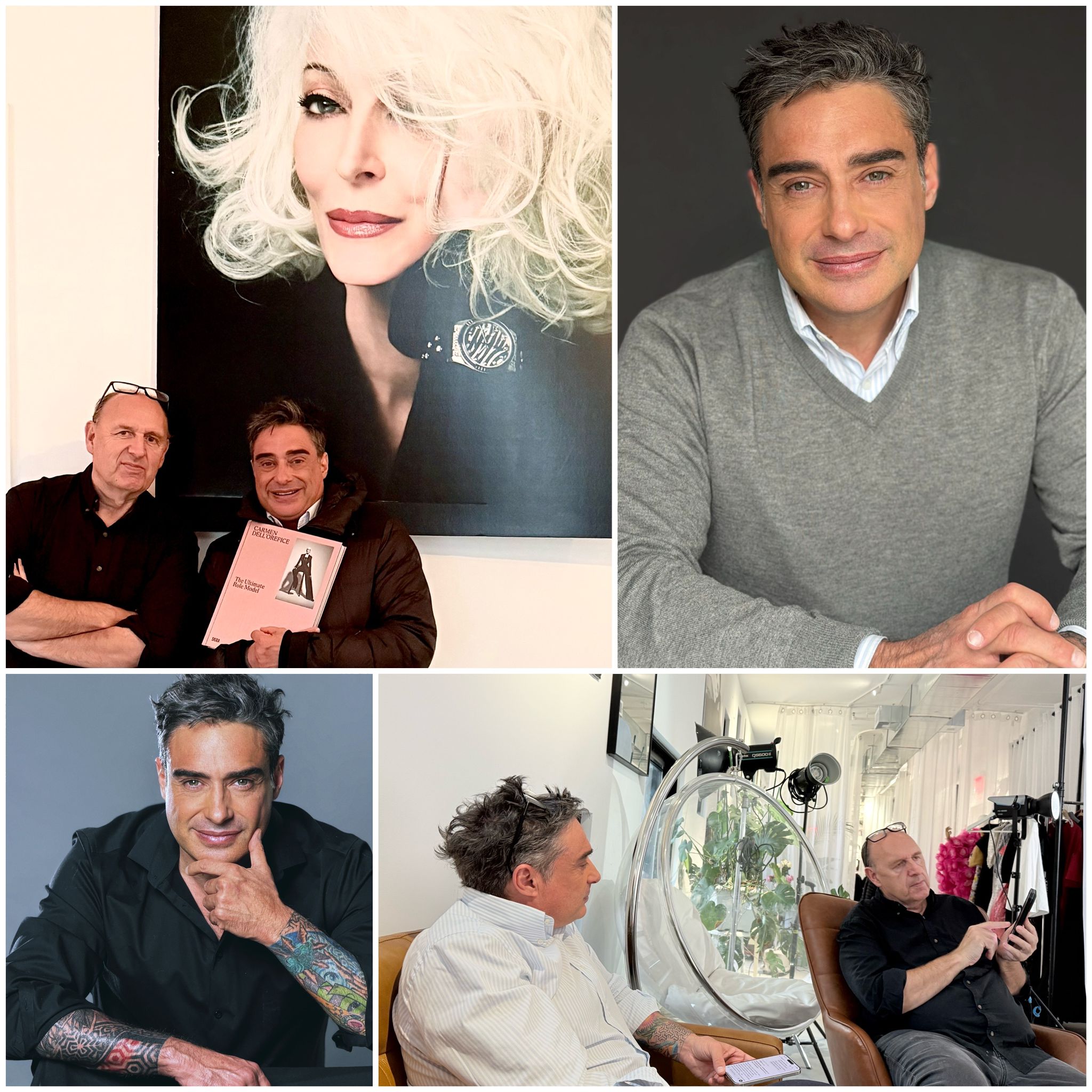
I push open the door of Fadil Berisha’s New York studio and I know, immediately, that I am not simply entering a workplace. I am stepping into a listening space. The walls look back at me: actors, models, artists, ordinary people. Faces from every corner of the world. Yet what strikes me most is not the fame in the frames, but the silence – a quiet respect for the stories behind each portrait. I am here as President of the Institute for Advanced Studies and Cooperation, but also, and perhaps above all, as a scholar and a friend. Today has a very precise purpose: to understand how Fadil’s creative and deeply positive way of seeing can become one of the living foundations of The Metaverse of Trust, the initiative I am developing to bring ethics, education and beauty into the digital future.
We sit down, surrounded by lights and lenses. The studio is both laboratory and sanctuary. We begin to talk. The conversation flows naturally: his childhood in Kosovo, the early years in New York, the rigor of his craft, the responsibility he feels towards the young people who arrive in his studio full of dreams and vulnerability.
He smiles and says, “Let’s shoot some pictures, let’s make it fun while we talk.” In a moment he becomes one with the studio and his assistants, a synchronised, almost omnipresent being, in touch and in control of all the elements – the light, the camera, the team – and at the same time fully present with me. I see the ease of a master and the attention of a mentor coexisting in every gesture. As he moves and speaks, I recognise something familiar. We are using different tools – he works with a camera, I work with projects that move between technology, diplomacy and education – but we share the same underlying question: how do we honour the human person in a world that moves faster every day? I describe The Metaverse of Trust as I see it: an ecosystem where education, digital media, gaming and new economic models converge around a single axis – the dignity of the human person. A place where young people are not reduced to users or data points, but invited to become co-creators. A world where technology is powerful, yes, but where values set the direction. Fadil immediately grasps both the potential and the risk. He knows how easily an image can create illusions, fuel comparison or flatten identity. He has seen it for decades in the fashion and media industries. Yet his work constantly moves in another direction: he searches for aesthetic excellence without sacrificing truth; he celebrates beauty without erasing age, culture or imperfection; he uses visibility not as a mirror of vanity, but as a platform for stories that matter. We walk through the studio. He points to some of his portraits: faces marked by time; young models at the beginning of their journey; personalities from the Albanian and Balkan communities; icons such as Carmen Dell’Orefice. For each image, he speaks not only of light and composition, but of character, resilience, wounds, dignity.
As I listen, I realise that this way of looking at people is exactly what we need to build into The Metaverse of Trust. Not as decoration, but as structure. We begin to imagine how his visual ethics can become part of the architecture of the project. We talk about a “visual grammar of trust”:
– how we portray faces and bodies without falling into clichés;
– how we represent diversity in a way that feels authentic, not tokenistic;
– how we resist the subtle violence of forced perfection. The conversation naturally shifts to the younger generation. Many live immersed in a continuous stream of images, but few are helped to understand what they see. We agree that our collaboration must have a strong educational dimension. Inside The Metaverse of Trust, Fadil’s experience should not only shape the aesthetic; it should become a school of visual literacy – a place where young people learn not only to produce images, but to read them, to question them, and to use them responsibly. When I step out of the studio that evening, New York is already slipping into its winter light. I walk back onto the street with a clear sensation: the presence of Fadil Berisha on this journey is, for me, a guarantee that beauty will not be separated from responsibility, and that the faces we meet in our digital future will still be recognised as human, fragile, unique – yet powerful. This is the collaboration we are shaping now: a photographer who dedicates his talent to honouring the human spirit, inclusion and creativity, and a project that seeks to bring ethics and trust into the heart of the emerging digital world. It is a story in progress, but it begins from a simple conviction we both share in this present moment: talent reaches its highest form when it is used to inspire, protect and guide.